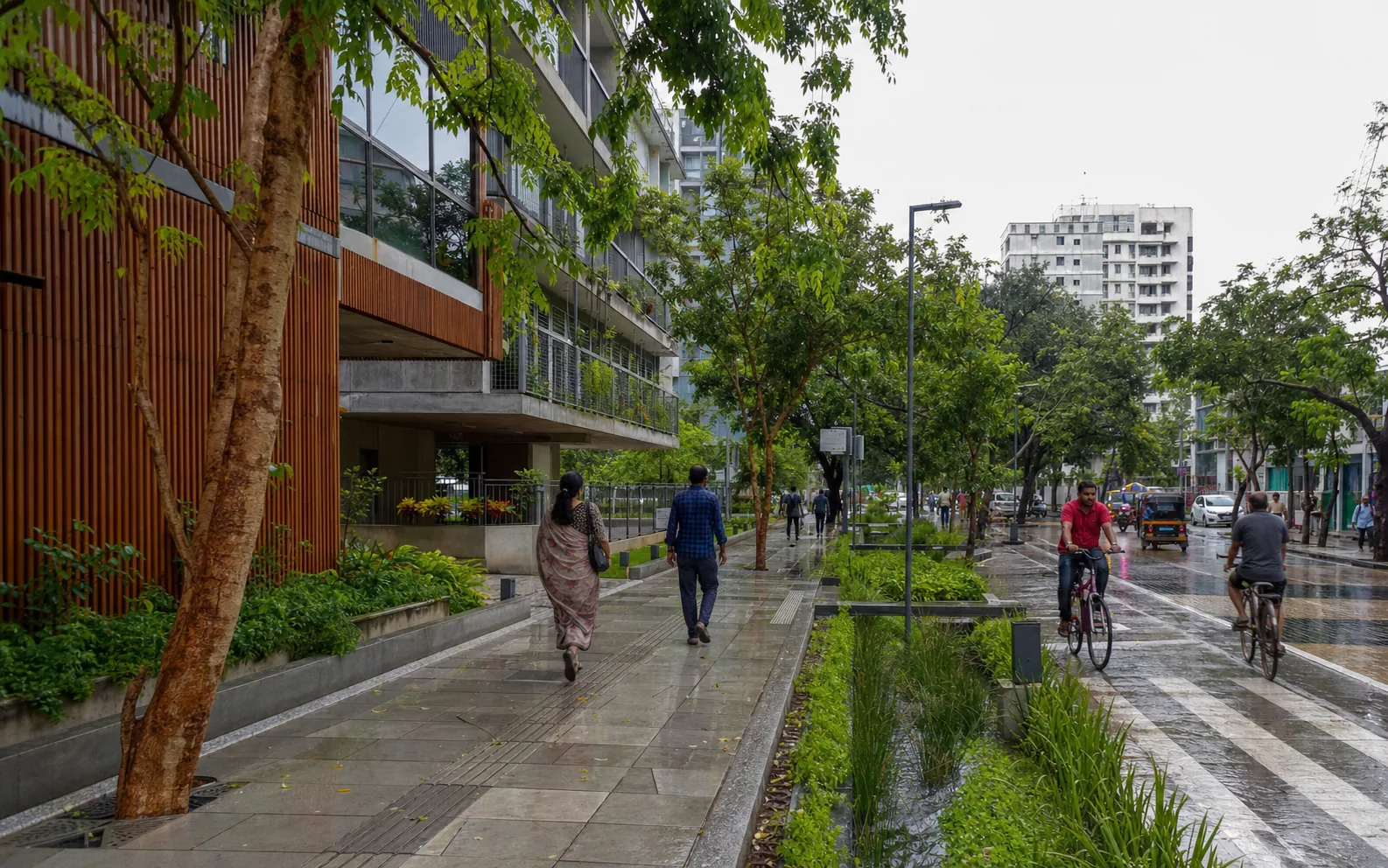
A good city block is rarely defined by one remarkable building. Its quality emerges from connections: the shade that continues past a property line, the crossing placed where people actually walk and the rainwater that has somewhere useful to go.
Design for the slowest journey
Street plans often begin with vehicle movement and fit pedestrians into the remaining space. Reversing that order changes the questions. Can a child cross without rushing? Can an older resident rest in shade? Can a wheelchair move from the bus stop to a shop without entering traffic?
When the slowest journey works, faster journeys tend to become clearer too. Predictable crossings and separated movement reduce conflict for everyone.
Treat shade as infrastructure
In hot cities, shade determines whether public space is usable. Mature trees, arcades and carefully placed canopies form a continuous thermal network. A shaded footpath that ends abruptly is less useful than a modest route that protects the entire trip.
Trees need soil volume, drainage and maintenance access. Planting them as decoration in narrow pits produces a photograph, not a canopy.
Make water visible and useful
Rain gardens and permeable edges can slow stormwater while making a street greener. Their success depends on ordinary details: safe overflow routes, filters that can be cleaned and planting that survives both dry weeks and intense rain.
Resilience becomes real when it improves an ordinary Tuesday, not only an emergency plan.
Leave room for adaptation
Neighborhoods change. Shops open, delivery patterns shift and new transit arrives. A durable block provides clear structure without fixing every use forever. Generous ground floors, accessible utilities and flexible curb space let the street adjust without losing its public purpose.
The climate-ready city is not a distant technical object. It is a sequence of comfortable, connected choices made at walking speed.